This article introduces a simple, repeatable model to track how companies can contribute to open source projects and realize benefits in return
This is the first of a series of three articles. Find the second one, which practical advice on how to apply this framework, and the third one, which describes an evolution of the model
Introduction
When I design or analyze how a company contributes to — and captures value from — an open source project, I use a simple model. This model helps me:
- Get an overview of all relevant elements
- Design a plan for how the organization should participate at business, product/service, and technical levels.
- Communicate that plan and explain why it matters to different teams and decision-makers.
- Stay focused on key goals and measure progress.
This is not a formal framework. Instead, think of it as a practical tool — a starting point that I adapt as the company and the project evolve. At some point, if the company’s processes become mature enough, they can replicate them without my help. That is when I know the model has served its purpose.
My goal with this article is to share this model with you so you can try it, adapt it to your own situation, and hopefully help me improve it.
References
This model takes inspiration from systems thinking and techniques like user story mapping and value stream mapping. I also apply business intelligence principles to ensure results are measurable.
A name
I call this model the “virtuous open source cycle. Strictly speaking, a more accurate name would be “contribution–value return cycle” or “value flow of open source“, since the “virtuous” part only happens once you invest enough effort, passion, and capital — and apply the model correctly — to make it self-sustaining.
Model description
We will start with the simplest model I work with, which is the following:

Two environments
There are two environments:
- the open
- the corporate environment, behind the firewall. Call it closed
The open environment refers to the public, collaborative space of the open source project, while the closed environment is the company’s internal space, including its tools and products.
Two systems
Two systems:
- open source project: the target of the contributions and the source of value the corporation wants to capture
- corporate product or service: this is the target for the value captured
Two paths
There are two main channels in which value moves: contributing resources to the open source community, and capturing returns for the company. I refer to these value flow channels as:
- Contribution path
- Value capture or the return path
In the diagram, the contribution path is thinner than the return path. That’s intentional: the goal is for the return path to outperform the contribution path — so the value that comes back is greater than what was invested.
Value types, what flow
Different kinds of value flow through these paths. The most relevant at first are:
- Assets: Tangible or intangible resources contributed to or derived from an open source project. These include code (source code, documentation, tests, etc.) and non-code assets such as infrastructure, hardware (development boards), lab environments, or technical facilities.
- Effort:The human contribution expressed in full-time equivalents (FTEs), differentiated by contributor skill levels (e.g., junior vs. expert/senior) relative to the domain of the open source project. Effort captures the direct labor invested by individuals in development, maintenance, management, or community participation.
- Capital: Financial resources allocated to support or benefit from the project. This includes direct funding (project sponsorship, developer salaries), indirect returns (cost savings, efficiency gains), and expenditures on supporting activities (contracted services, travel, infrastructure). In essence, any budgeted monetary flow linked to participation and value generation.
- Influence: The organization’s capacity to shape the direction, scope, or governance of an open source project. Influence typically arises through sustained participation, capital contributions, or employing significant project contributors. It is primarily a contribution-side value and usually materializes gradually over time.
- Reputation: The credibility and recognition an organization and its affiliated contributors build within the open source ecosystem. It emerges from demonstrated expertise, reliability, and trust, and generates long-term return value in the form of stronger relationships, talent attraction, and ecosystem visibility.
Activation energy
Once the channels are set, to make the cycle work, you must reach a threshold I call activation energy — the minimum combination of assets, effort, capital, influence, and reputation needed to start a self-sustaining flow of value. The exact threshold depends on factors like project maturity, your internal processes, and your team’s experience. You will not know its “amount” in advance but you realise that you already went through it after the fact.
Additional value types (over time)
Overtime, there are three additional types of value I consider:
- Developers satisfaction: the intrinsic motivation, sense of accomplishment, and professional fulfillment that participating developers experience. It supports retention, productivity, and long-term contribution.
- Brand impact: the reputational and marketing benefits that accrue to the organization through association with open source projects. These include increased visibility, improved market perception, thought leadership signaling, and alignment with open innovation values.
- Knowledge transfer: the acquisition and dissemination of domain expertise, skills, and practices gained through active participation in open source. This extends both within the contributing organization (internal learning) and outward to broader industry networks.
Now that we have described our model, let’s map it with reality
Applying the model to a real case
The first step is to identify:
- The target open source project you will contribute to.
- The product or service that will benefit from the captured value.
Narrowing these systems as much as possible helps reduce complexity, focus effort, and make measurement easier.
Considering activation energy
The activation energy threshold depends partly on the maturity of both systems — the project and your product/service. Mature, well-structured systems make it easier to define and establish contribution and return paths.
Effort is often the most expensive value type for the company. Choosing projects where your team already has expertise may lower the activation threshold. Alternatively, selecting a project in a new domain may be strategic if gaining knowledge is part of the goal — just document this clearly.
If you are experimenting with this model for the first time, keep it simple.
Paths
Both the contribution path and the return path should be described end-to-end, using milestones, events, and processes. The goal is a simple, observable, and easy-to-communicate map of how value flows.
A useful method is value stream mapping — a way to visualize all steps from idea to delivered value — adapted here to open source.
Contribution path
Start by identifying gates and gatekeepers. If approvals or policies block contributions, value cannot flow. Ensure contribution, legal, labor, financial, export control, etc. requirements are in place and understood by everyone involved. The processes to meet and audit them must be in place.
For instance, let’s assume that the the organization develops and test the code code in-house, once the peer-review is done, some compliance related checks are performed, When approved, the code is contributed to the open source project. The contributed code is tested in the open, a request is created, including testing evidences, the patch set is reviewed by a maintainer, tested in the project’s main pipeline, approved and finally merged. Finally, the contributed code is made available so it can be distributed (built, encapsulated, virtualised…) and, some time later, released. This workflow can be represented as:
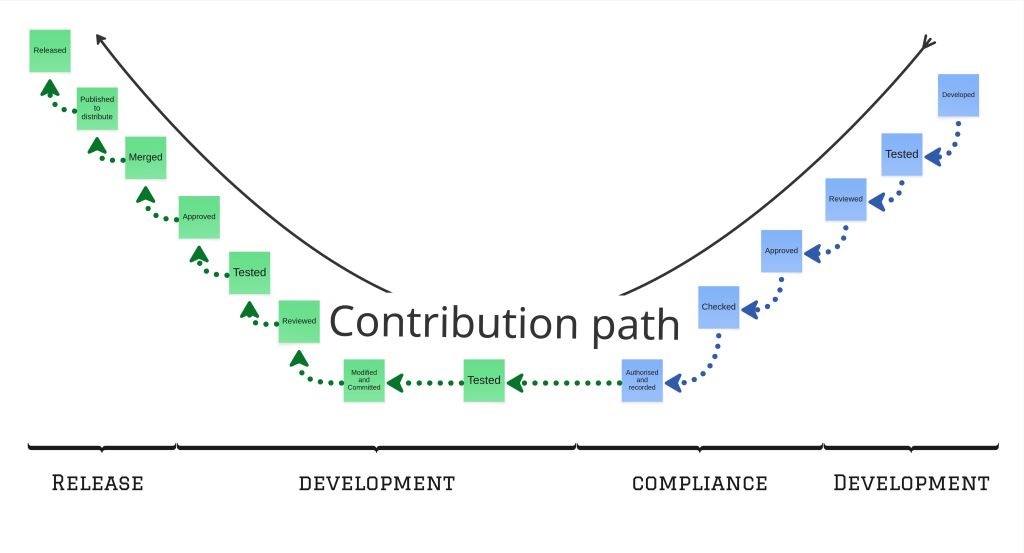
At first, describe only key milestones — you can refine details later. For guidance, the example is too detailed. Remember, we are trying to make a complete, end-to-end, comprehensible picture of the model, mapped with reality.
Return path
Use the same method to map the return path. Importantly, the return path does not end when code lands in your repository — value is only realized when it reaches your customers (internal or external). At first, it might be enough with having the ability to track the code’s journey across the internal production process up to the product or service release or deployment.
Assume for a moment that you will consume only versions that are released, not development versions.let’s imagine that there is an inbound process at the organization where simple automatic checks are performed before the code is tested in the corporate environment, including specific hardware, results are reviewed and manually approved. The the code is merged in the target repository. More complex compliance (security, copyright, license, provenance, duplication, etc) checks are performed, reviewed and approved. Finally the code is tagged and signed, so it can be tracked across the production environment.

Again, this example is too detailed to start with. Start by simply describing the milestones.
Value types and metrics
Tracking value types is essential — it allows you to justify investment, report results, and convince decision-makers to continue supporting open source work. This is an example of the value types involved on the contribution path:
- Effort
- 2 FTEs among 4 staff
- 1 dev. engineer
- 1 platform engineer
- 1 tester
- 1 architect
- 2 FTEs among 4 staff
- Capital: 1 year budget 50k €
- 30k € coaching/engineering services
- 10k € infrastructure and platform services
- 5k € community ecosystem membership
- 5k € other expenses
- Add the cost corresponding to the assigned staff for 2 FTE
- Assets
- Hardware
- HW to add to the testing lab
- Development boards/devices
- Hardware
- Code
- Define here the software and artifacts you are planning to contribute, if any.
- Documentation associated to the code
- Services
I suggest to avoid the definition of the rest of the value types in advance. Wait al least until the target areas of the open source project are well understood. If you still have to define then early, consider describing simple goals that can be tracked and adapted later on.
I provide here some ideas on how to describe the other value types
- Influence:
- Code merged upstream: Count of pull/merge requests accepted, showing direct technical impact.
- Areas of code reviewed by staff: Number of code reviews performed by employees, indicating participation in project quality assurance.
- Leadership roles: Presence of employees as maintainers, release managers, or technical steering committee members, reflecting governance influence.
- Authorship ratio: Share of commits authored by organization staff compared to total commits, demonstrating development footprint.
- Decision-shaping contributions: Number of proposals, RFCs, or design documents from staff that were accepted, showing strategic influence.
- Roadmap impact: Count of proposals, features, or RFCs accepted that originated from your organization, showing strategic guidance.
- Dependency ownership: Number of critical project components where your organization is a key maintainer, highlighting leverage in technical direction.
- Voting power: Participation and success rate in project-level voting or consensus processes, showing leverage in community choices.
- Reputation:
- Contributor credibility: Number of times staff are publicly recognized or thanked by project maintainers, reflecting trustworthiness.
- Community endorsements: Mentions in community reports, blogs, awards, certificates, or talks praising contributions, signaling respect and reliability.
- Speaking invitations: Requests for employees to present at conferences or participate in panels due to recognized expertise.
- Recruiter interest: Increase in inbound job applications citing the company’s open source work as a reason for applying.
- Project leadership recognition: Invitations to join governing boards or steering groups based on proven reputation.
- Social proof: Positive engagement on posts highlighting your open-source efforts, demonstrating community validation.
- Reference by Third Parties: Having the organization cited in industry analyses, blog posts, or academic studies validates its stature as a respected open source participant.
- Developers satisfaction:
- Retention rate: Percentage of contributors who remain active over a given period in both, the open source project and the organization, indicating engagement.
- Internal survey scores: Results from employee pulse surveys about motivation, autonomy, and satisfaction related to OSS work.
- Skill growth: Number of employees gaining certifications, presenting at conferences, or moving into higher technical roles. Perception from their peers at the organization.
- Voluntary advocacy: Instances of employees blogging, speaking, or mentoring about the project outside formal duties, showing intrinsic motivation.
- Feedback in retrospectives: Positive mentions of open-source work in internal team reviews or retrospectives, capturing qualitative sentiment.
- Contribution impact: Increase the impact of the contributions internally at the organization over time, reflecting both experience and sustained enthusiasm.
- Community belonging: The fulfillment that comes from being an active and respected member of a vibrant community.
- Brand impact:
- Mentions in community channels: Count of times the organization is acknowledged in release notes, blog posts, reports, mailing lists…
- Conference visibility: Number of talks, workshops, or panels delivered by employees at project-related events.
- Corporate website traffic: Visits to open-source-related landing pages, measuring external interest.
- Social media reach: Engagement (likes, shares, comments) on posts about the project from corporate accounts.
- Ecosystem partnerships: Number of collaborations or joint announcements with other ecosystem players, signaling market presence.
- Media coverage: Articles or analyst reports citing the company’s role in the project, showing thought leadership recognition.
- Knowledge transfer:
- Internal training sessions: Number of brown-bag talks, workshops, or wiki articles created based on open-source learning
- Cross-team collaboration and adoption: Cases where knowledge from OSS participation is applied by teams not directly involved in contributions.
- Documentation updates: Internal docs improved due to upstream participation, reflecting institutional learning.
- Mentorship instances: Employees mentoring colleagues on technologies first learned through project work.
- Best-practice adoption: Uptake of project’s CI/CD, security, or quality processes within internal teams.
- Innovation outcomes: New features, services, or optimizations derived from insights gained in the open source project.
Summary
This article described the simplest version of my model for designing, communicating, tracking, and reporting a company’s participation in an open source project. We reviewed its core elements, discussed how to map it to reality, and listed example metrics for key value types.
In the next article, I will share practical advice on how to use this model and explain some of its limitations. If there is interest, I may write a third article to show how the model evolves to support more complex environments and mature open source strategies.
Remember that there are other articles corresponding to this Open Source Value Flow Model series:
 toscalix
3 thoughts on “The virtuous open source cycle: model description”