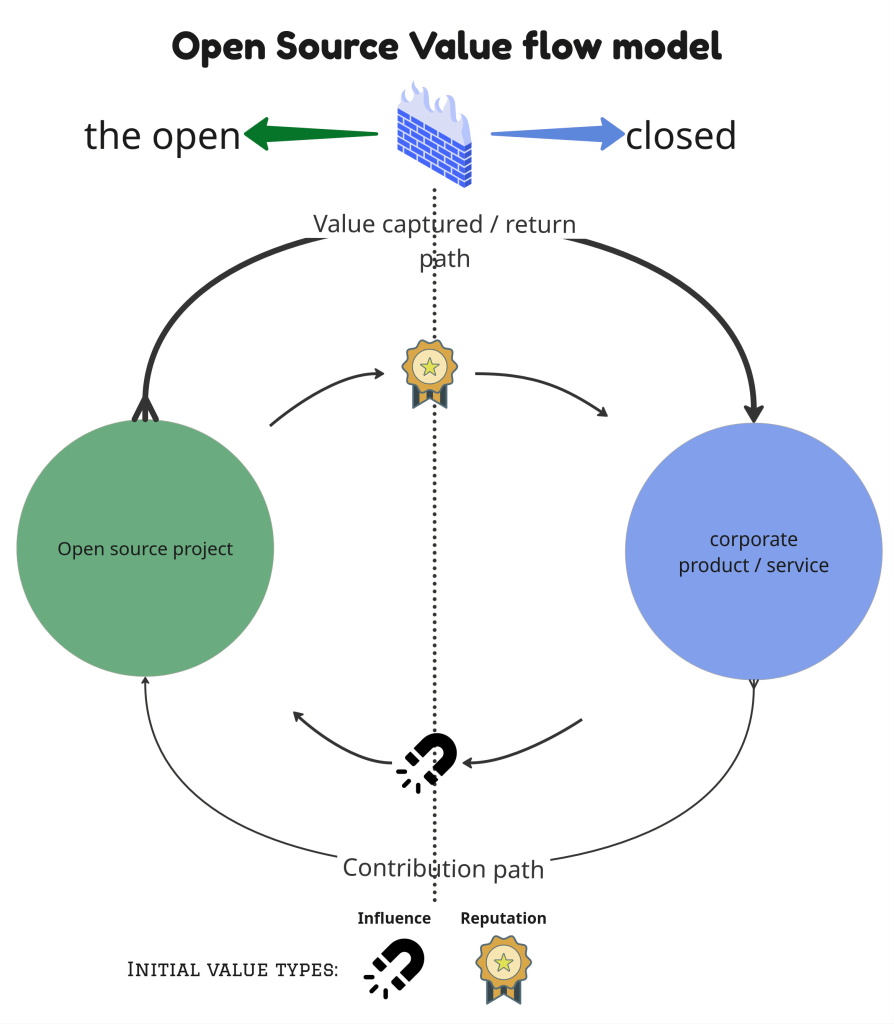
This is the forth article of the series describing the open source value flow model. We’ll focus on the value types: Reputation and Influence. We’ll cover how to measure and report on them.
If you haven’t yet, please read the first two articles:
- Article One: The Virtuous Open Source Cycle: Model Description
- Article Two: From Theory to Practice: Leveraging the Virtuous Open Source Cycle for Long-Term Success
You can save the third article for later.
Reputation and Influence are distinct but related value types in the model. They are both forms of social capital in open source.
- Reputation is about how others perceive a company’s reliability, expertise, and contribution quality. It is the value a company earns and captures.
- Influence is about the company’s ability to guide a project’s direction and decisions. It is a value the company builds and contributes.
Describing Influence
Influence represents the organization’s capacity to guide the technical, governance and strategic direction of an open source project. It is gained and built gradually through sustained contributions and strategic investments.
Influence lets a company co-create the project’s future. This ensures the project’s outcomes align with the company’s needs, all while respecting the community’s mission, values, policies, and processes. Therefore, influence reduces the risk of the project and company drifting apart (divergence). This makes sure the value returned to the company is both relevant and increasingly useful.
Describing Reputation
Reputation is the social credibility and trust a company earns from the open source community. You build it through consistent, high-quality contributions and ethical engagement. It reflects how everyone—maintainers, contributors, adopters, and even competitors—sees your company’s reliability, commitment, the expertise and goodwill of your staff.
Reputation functions as the outcome of consistent participation and contribution. It is cultivated. It helps the company build stronger relationships inside and outside the project.
In the virtuous cycle model, reputation corresponds to the “return” phase of participation.
Relation between influence, reputation and ROI
Reputation and influence reinforce each other. Reputation is the invitation—the trust that earns a company a seat at the table. Influence is the handshake—the ability to use that trust to shape project outcomes. Companies typically earn influence only after establishing reputation. This creates a cycle where participation builds trust, trust leads to influence, and influence enhances both open source project and business alignment.
Both reputation and influence boost your Return on Investment (ROI) by turning social capital into real outcomes:
- Influence creates strategic ROI for both parties by co-creating a more sustainable future for the project and by aligning project roadmaps with product needs.
- Reputation delivers operational ROI by:
- Increasing visibility and improving brand perception.
- Reducing friction in future collaborations.
- Attracting and retaining talent.
- Quickly building credibility (a sales tool).
- Increasing adoption of the project’s technology within and outside the company’s market.
Together, influence and reputation shift open source engagement from a cost center to a strategic advantage for the company.
Metrics
Reputation Metrics
Reputation metric can focus on:
- Leadership
- The number of technical and community governance roles (elected or appointed by consensus) held by company employees in key areas for the company and the project.
- Number of keynotes and content committee invitations for events.
- Number of participations at invitation-only events and forums.
- Engagement
- Data such as stars, clones, forks, downloads, code reviews, and forum activity.
- Results from internal developer surveys assessing awareness of the company’s open source activities and their positive influence on perception or willingness to collaborate.
- Feedback from partners and ecosystem members.
- Open Source project ecosystem members turned into partners through collaboration.
- Engagements with prescriptors (technical experts who influence purchase decisions) from the open source project ecosystem.
- Visibility
- The number of positive public mentions of the company or its contributors in official project communications, documentation, forums, release notes, blogs, and social media.
- Endorsements in public and neutral reports, testimonials, or blogs.
- Public talks provided about the contributions.
- Adoption
- Internal adoption.
- Adoption within the company’s ecosystem.
- Adoption beyond the company’s ecosystem (pay special attention to adoption by competitors).
- Talent
- Job applications referencing the company’s open source work.
- Hires of project contributors, especially core contributors: time to hire, cost reductions, seniority of candidates.
- Retention rates among contributors (staff) versus similar staff who are not contributing. (Tip: Feed existing HR metrics to save the effort of creating and maintaining new ones.)
I recommend including qualitative indicators that measure perception and sentiment alongside hard outputs. These indicators show trustworthiness and community endorsement, highlighting how well your actions translate into social capital.
Marketers often focus on metrics related to social media, engagement, website redirection, and conversions. I suggest ignoring those until your value tracking system and reporting process is mature.
It is important, to agree with departments like business development, partnership, and customer support/success on ways to track and analyze how your activity in open source impacts their everyday work and results.
Influence metrics
I’ve seen organizations focus too much on tracking influence only within the open source project, and forgetting to track influence within other areas of the company, the company’s ecosystem, or its broader market.
Influence metrics might include:
- Meaningful contributions
- The number of merged pull requests, upstream features initiated, contributed by, co-authored, reviewed, or signed off by the company staff (contributors).
- Number and impact of project decisions where company contributors played a leadership role (through voting, positioning, or building consensus).
- Bugs detected, reported, screened, or fixed by contributors from the company.
- Project health metrics positively influenced by company contributors and their work.
- Alignment…
- Alignment between the company’s product roadmap and the open source project roadmap. Track the evolution of this alignment (gap analysis).
- Alignment in the architecture evolution of the product and the open source project.
- Alignment in the technologies created, used, and/or vetoed within the open source project and within the company. Link the commodity features developed upstream with the differentiation features developed in-house.
- Alignment in development, delivery, and maintenance processes as well as strategies like testing and platform support. (Pay attention to testing activities in the open, which are often underrated within corporations but extremely valued when brought to surface.)
- Adoption throughput and dependencies:
- How fast company contributions move from proposal to inclusion in the project outputs. How fast these contributions and other project outputs reach downstream users.
- How many company contributions and project outputs are adopted by the company, by the company partners (ecosystem), and by other open source projects.
- How the friction to consume and maintain the open source project outputs evolves internally, within the company’s ecosystem, and across its market.
- Others
- Community events hosted by the company: amount, nature, and outcomes.
- Maintenance activities performed upstream versus downstream, and the resulting impact on rework.
- Onboarding your company ecosystem members and developers into the open source project.
How to report about reputation and influence to reflect ROI
Reporting on Reputation and Influence to executive decision-makers requires translating technical and community metrics into the financial and strategic language of Return on Investment (ROI) and business risk mitigation.
To achieve this translation, reporting should shift from simply presenting the raw metrics (e.g., “We have 5 maintainers”) to showing the direct business impact those metrics enable (e.g., “Our 5 maintainers reduced our internal development costs by X”).
Connecting Reputation to Business Outcomes
Reputation maps directly to classic business concepts like brand equity, talent acquisition, market positioning, and business development. When reporting on Reputation, focus on the value captured by the company through the Return path.

- Talent Acquisition or “The Cost of Hiring & Retention”:
- A strong reputation reduces recruiting costs (less reliance on third-party recruiters), shortens time-to-hire for specialized roles, and makes candidates with public exposure easier to evaluate compared to blind scrutiny.
- Report the reduction in average time-to-hire or the percentage of open source hires coming directly from the project community versus traditional channels.
- Brand Equity or “Marketing & Credibility Spend”:
- Community recognition (staff keynotes, invitations, awards, endorsements) generates brand awareness and technical credibility that would otherwise require significant marketing spend.
- Support your marketing department by feeding their Brand Lift metric.
- Operational Friction or “Speed of Alignment”:
- High reputation means other maintainers and collaborators are more willing to accept your contributions and work with you, lowering the friction to merge key features your product depends on.
- You can report the decrease in average Contribution Adoption Throughput (time from PR creation to merge) as a proxy for operational efficiency. You can also focus on cost avoidance.
- Business development:
- Collaborating in the open might lead to partnership opportunities, new qualified leads, new R&D projects, and market expansions.
Connecting Influence to Business Outcomes
Influence is essential for guaranteeing that your contributions align with your company’s long-term business goals. When reporting on Influence, focus on the Contribution Path and the Mitigation of Strategic Risk.
- Architectural Alignment or “Reduced Cost of Divergence”:
- The ability to influence the project’s roadmap and architecture reduces the long-term risk of divergence. This divergence, or creating an internal fork, means significant unexpected development and maintenance costs.
- Report this as Cost Avoidance achieved by steering the project’s evolution toward your product roadmap, based on a gap analysis.
- Early Adoption Opportunity or “Competitive Advantage & First-Mover Status”:
- Active influence means your teams get early access to forthcoming features (often your own code, before others). This allows you to develop product differentiation features sooner or provide internal features to developers earlier, maximizing efficiency ahead of competitors.
- Report on the early feature adoption rate and map it to specific product milestones or market opportunities accessed ahead of competitors.
- Dependencies & Security or “Total Cost of Ownership (TCO)”:
- Having staff in key roles allows the company to directly influence security and maintenance strategies. This lowers the long-term Total Cost of Ownership (TCO) of using the project’s outcomes.
- Report the reduction in critical vulnerability triage time or the reduction of effort in forward-porting non-upstreamed features as evidence of a direct operational benefit.
General considerations
Start small and build the reporting from the ground up. To me, the ideal open source strategy is that… there is no specific open source strategy. I try to follow this principle by embedding open source activity across the companies I help. I usually phrase it as: “The open source strategy is the company/product strategy, and the company/product strategy is the open source strategy.” I apply this strategy to reporting as well.
Agree with different departments on which metrics and insights you will focus on for executive reporting, complementing the existing reports. Consolidate the insights into a high-level dashboard that avoids jargon and emphasizes the net value derived from the virtuous open source cycle.
It usually takes several iterations before executives trust and consider your reports. Reaching the level of departments who have been reporting for years won’t be easy. You may never reach that point, but the effort is completely worth it.

Combine any metrics impacting cost savings with those impacting cost avoidance. You can do this by focusing on “saved effort,” adding the sense of challenge that knowledge gaps represent to create in-house what is created in the open. Contrast those cost savings and cost avoidance with the total investment so you can present a simplified, executive-friendly Net ROI figure.
Use simple visuals to show the evolution over time of the Roadmap Alignment Gap (how much the project’s direction matches the company’s needs). A shrinking gap indicates successful Influence and higher strategic certainty.
I like to use colors (Red, Amber, Yellow, and Green). I define one of them based on risks and opportunities (I always include both. Why do so many people talk about open source only in terms of risks?). Then present the report of the activity in the open and achievements as a journey (time) where the company meets milestones, towards turning the items into a green color. I use shapes, sizes, or the Y-axis to provide a sense of effort and challenge. Remember that, unlike other areas of the business, in open source you do not control but influence.
Visually relate the journey to the model, mapping influence and reputation metrics to the actual stages in your Contribution–Return Cycle. Show how each metric reflects movement from contribution to captured value.
Complement the report with testimonials and stories from staff and external people. Executives are sensitive to the opinions of reputed professionals, competitors, and partners. For sales professionals, narratives are as important as numbers. These testimonials and narratives are hard to get and create, but powerful and engaging for these two audiences. Work to get them.
Add a section of “next steps” providing clear expectations and goals and comparing achievements versus expectations. Show that this is a learning process the company is getting better at.
The same report can be meaningful to some but say very little to most. I usually tailor my reports for:
- Technical audiences
- Product people
- Marketers and business developers
- Executives and decision-makers
Choose a cadence and the right internal channels for each audience. Unless you want to do nothing else, you’ll need everyone involved in open source activities to feed your reports. Design it as a collaborative effort… or die trying.
Is there a company (competitor or market reference) you can benchmark against? Even if it is qualitative, use it. Executives understand market positioning like nobody else. Providing them references helps.
Summary
In short, the goal is to build social capital (reputation and influence) and turn it into measurable actions. This moves the conversation from “We spend money on contributing to open source for reason X” (the cost center view) to “Our investment in the Contribution/Return Cycle model is a strategic tool that generates < specific, measurable value > in < business topic >, providing < business impact and effects >” (the opportunity view).
Link those effects to cost savings, faster delivery, new opportunities, and risk reduction, using the model to simplify the understanding of the complex environments you work in.
When consistently reporting about reputation and influence, it is simpler turn the virtuous cycle into a measurable, repeatable process that can scale up, showing how contribution leads to return. This connection makes the return visible to executives and better justifies the investment in open source participation, in my experience.
Remember that this is the fourth of a series of articles describing the open source value flow model:
- Article one: The Virtuous Open Source Cycle: Model Description
- Article two: From Theory to Practice: Leveraging the Virtuous Open Source Cycle for Long-Term Success
- Article three: Part 3: Evolving the Model by adding a company-driven open source project
Article polished with AI. Images two and three made by Grok


3 thoughts on “Value Types: Reputation and Influence”