Knowing what each AI openness term means is the first step. Knowing how the terms relate to each other is the next one.
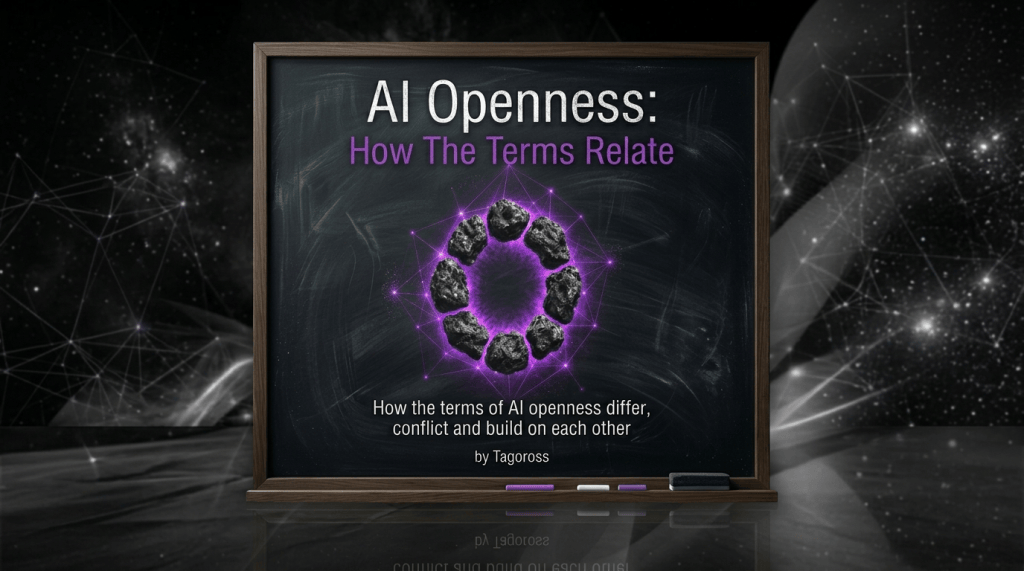
Download AI Openness: How The Terms Relate
A new resource in the AI Openness series
On 5 November 2026, Tagoross released the third resource of the AI Openness series. The series is a set of documents, guides and diagrams. This new resource is called AI Openness: How The Terms Relate. It is package 3 of 5.
It includes a document and a diagram. Both describe the relations between the terms defined in the first resource of the series, the AI Openness: Terminology and Definitions guide.
Who the series is for
Tagoross designed this third resource for people with limited knowledge of open source software and open data compliance, or of the legal side of it. It helps them understand the terms and some of their implications.
The goal of the series is to give these people the resources to identify and evaluate the vendor lock-in and sovereignty risks associated with AI models.
Tagoross brings together open source experts and professionals who work at the crossroads of open source and business. Many Tagoross Members are not proficient in open source compliance or legal matters. Still, they need to evaluate investments in AI, and vendor lock-in and sovereignty are essential factors to consider.
Six kinds of relations
This third resource structures the relations between the terms in six groups:
- Confused pairs. Two terms used as if they meant the same thing, or something close enough.
- Freedom counts. How many of the open source freedoms each licensing term for AI models grants.
- Builds-on. One definition’s bar contains another definition’s bar and adds more.
- Tensions. Two terms pull in different directions. Sometimes they even pull in opposite directions.
- Components. One term is an ingredient that another term needs.
- Thresholds. Which terms carry a number to define AI openness, and how binding is that number?
Like the guide, this third resource is dense. It is not meant to be read like a book. It is a supporting resource. That is why Tagoross included a diagram that works as a kind of index. You will find it on the last page of the document.
Why curated content matters in the AI era
With AI, writing and copying from others is simpler. In this context, I believe this document becomes more relevant.
Curated content that builds on other curated content has merit. It is not the same as simply going to an AI tool and asking questions. The relations between the terms were developed in a very specific context with a common goal, not just with a common design and look.
The relations are built on well-curated definitions, which are based on highly trusted sources and references. You can find them in resource one (the guide) and resource two (the timeline).
Join the workshop wait-list
The AI Openness series has five packages and ends with a workshop. In the workshop, I will show participants how to put into practice the concepts described in these documents and diagrams. Tagoross will announce the workshop date soon.
Fill out the wait-list form and you will:
- Help Tagoross shape the workshop. There is no commitment to join it.
- Receive package 4 and pre-release versions of future resource series.
- Join the Tagoross content review team.
- Receive invitations and discounts for upcoming activities.
Package 4: Classification matrix
- Inside: the classification matrix diagram and a document that explains it, with basic examples.
- How to get it: join the wait-list and you will receive a notification with information about how to download it when it is available.
- Terms: publicly available, with all rights reserved. This content is part of Tagoross IP.
Package 5: How to place a model on the matrix
- Inside: a how-to guide, a set of questions for discussion and the workshop.
- Who gets it: workshop participants and Tagoross Members.
- Terms: restricted.
- When: the workshop date will be announced soon.
What comes next and feedback
After the first series of workshops, where I will put all these resources to the test, Tagoross will publish a second version of this material. Tagoross already has improvements in the pipeline. It has also received requests for additional content, as well as remarks. Tagoross will revisit the licence of package 4 then. Hopefully, nothing will stop Tagoross from releasing it under a CC licence. No guarantees, though.
Thank you to Tagoross Members, to the review team and to everyone else who has already sent notes and corrections.
Tagoross welcomes feedback. Send your feedback, corrections and questions about these resources through the Tagoross contact form, or send them to me directly.
Where to find AI Openness: How The Terms Relate
Check the Tagoross website. If you are looking for AI Openness: How The Terms Relate, visit the Releases page. You will also find the guide and the timeline there.
Summary
Tagoross released AI Openness: How The Terms Relate, package 3 of 5 of the AI Openness series. The document and its diagram show how the terms of AI openness relate, so readers without compliance or legal expertise can evaluate vendor lock-in and sovereignty risks of AI models. Download it, join the workshop wait-list and send your feedback.
Which pair of AI openness terms do you see confused most often in your organisation? Which relation between the terms should Tagoross explore further in the next version?

